 jill
 September 30, 2017
 jill
September 30, 2017
Decades on the bike have taught me a great deal about performance, persistence, preparation and building self-belief.
Some lessons come from the races themselves. Others emerge from the miles, through experience, reflection and observation.
In this series, I share a few of the lessons the road has taught me, and what they might mean for life on two wheels and life on two feet.
Learning how to go further has many elements to it.
To ride longer, you usually have to ride differently. You may need to change your position on the bike, and you have to figure out how to fuel yourself hour after hour.
And then there is your mind.
When you start getting into really long hours, you have to confront your mind, or your mind will confront you.
I train my mind just like any other muscle. If I don’t, it becomes the weak link. And a mental weak link can be just as damaging as a physical one.
Training the mind requires the same discipline as training the body. You decide where you want to improve, apply consistent pressure and, over time, become stronger.
This is much more than positive thinking. It is the disciplined practice of thought that, over time, develops self-belief.
Let me give you an example.
There comes a point in every endurance race when thoughts such as these start to appear:
My body can’t do this any more.
I don’t have what it takes.
My opponents have me on the ropes.
I’m going to blow up.
He’s stronger than me.
I need to stop, rest or sleep.
I’m falling apart.
If those thoughts go unchecked, you start looking for evidence to support them.
You feel a pain in your back or neck and attach it to the thought, I’m falling apart. Then you feel a twinge in your quad or calf, and the thought gathers momentum. Before you know it, every discomfort becomes further evidence that you’re in trouble.
Of course, there is effort and discomfort. That’s ultra-racing.
The question is how you respond when those thoughts appear.
At the first sign of I’m falling apart, you have a choice. You can let that thought take hold, or you can challenge it.
You might remind yourself:
I know I’m capable.
I will find my way through this.
If I’m in trouble, they’re in trouble too. Stay steady.
I’ve trained for this.
Or you might ask a practical question: What can I change here? My gearing? My speed? My position?
Then you start looking for evidence that you are, in fact, finding your way through it.
Look at the data. Your heart rate, your breathing, your comfort level. Is there something you can adjust? Is the situation as bad as your mind is telling you it is?
Even small pieces of evidence matter. They give you something real to work with, rather than allowing your thoughts to run away with you.
Gradually, you begin to trust your ability to manage difficult situations. Your self-belief grows, and that belief can help you keep performing when things get tough.
I’ve learned something else about self-belief through experience. Sometimes, things don’t go to plan and, despite all your preparation, you fail to achieve what you set out to do.
That doesn’t have to be the end of the story.
Think about what happens in training. You apply a stimulus, allow your body to recover and adapt, and come back stronger. Failure in a race isn’t quite the same as reaching a physical limit in training, but the principle of learning and adapting still applies.
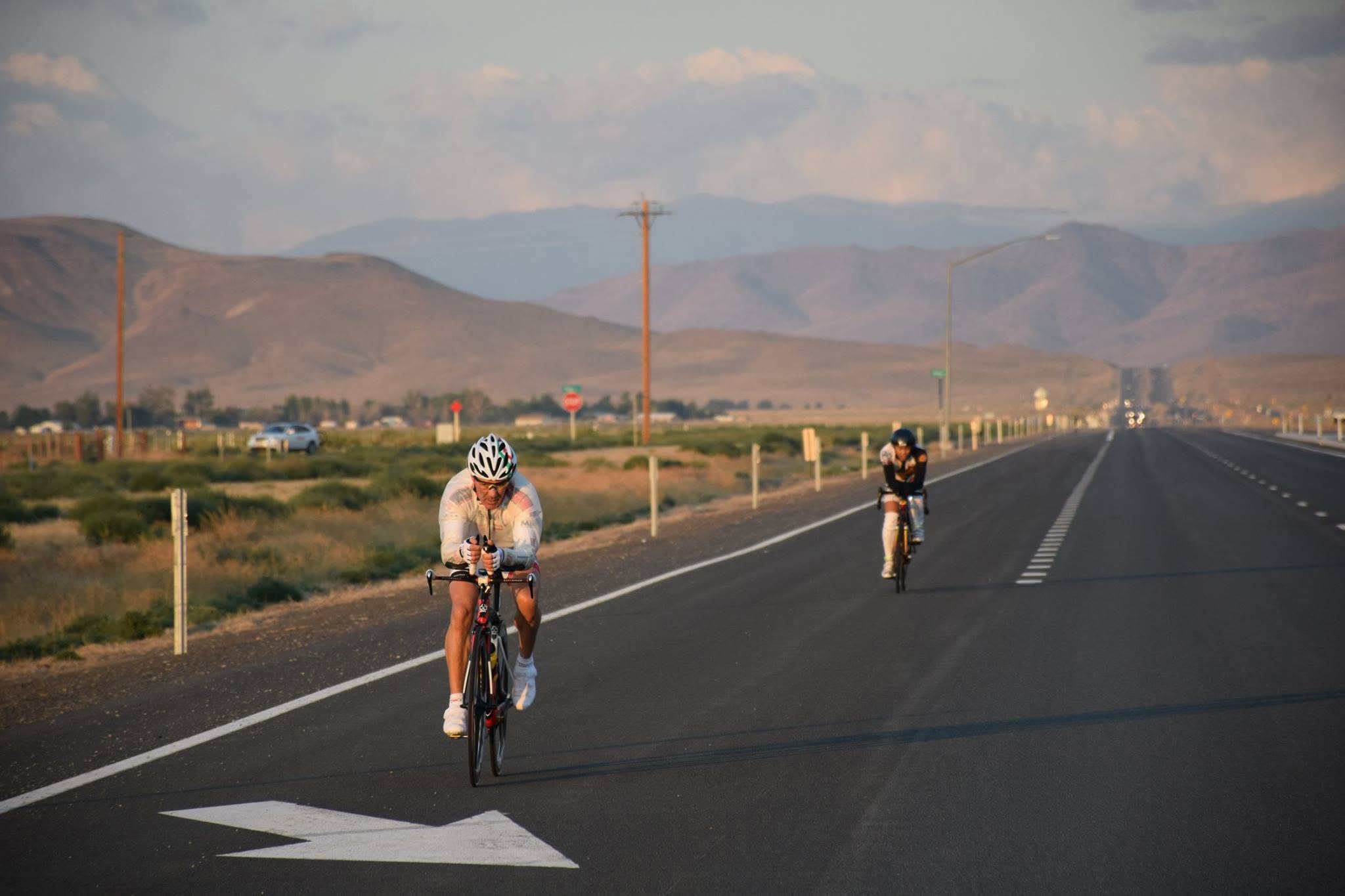
I’m thinking here about a record attempt in the summer of 2017.
I didn’t achieve the record I was aiming for. It would have been easy to take that experience as evidence that I wasn’t capable, or to let the disappointment undermine my belief in myself.
Instead, I took what I could learn from it, made the necessary adjustments, continued working on my mental approach and got back on the road.
The result was a category win at Silver State 508, a 500-mile race in Nevada, USA.
Was it easy? Not in the slightest.
It would have been much easier to find evidence to support the thought pattern, I’m a failure.
Instead, with the support of my team, I found evidence of how capable I had been during those 23 hours and 38 minutes of the record attempt. I could learn from what had happened without allowing it to define what I was capable of doing next.
That is the discipline.
Self-belief doesn’t mean you never doubt yourself. It doesn’t mean you ignore discomfort, dismiss genuine problems or convince yourself that everything will be fine.
It means learning to respond to difficulty in a way that helps you move forward. It means recognising what you can learn, finding evidence of what you can do, and giving yourself the opportunity to improve.
Our minds can be our greatest ally or our greatest critic.
Train your ally. It will come in handy when it all goes pear-shaped.
The mind is part of the training, but learning how to work with it takes experience, perspective and the right guidance.
Through Train with Joe, you can draw on Joe’s decades of racing experience to develop not just your physical capability, but the judgement, resilience and confidence to keep moving forward when the road gets difficult.
 jill
October 4, 2021
Decades on the bike have taught me a great deal about performance, persistence, preparation…
 jill
April 22, 2020
Decades on the bike have taught me a great deal about performance, persistence, preparation…
 jill
April 4, 2020
Decades on the bike have taught me a great deal about performance, persistence, preparation…
 PREV
 NEXT