 jill
 September 29, 2018
 jill
September 29, 2018
You’ve heard me say it before: the hardest part is often getting to the start line.
Even when Race Around Ireland is a home race, it practically requires a degree in project management. You’re dealing with people, administration, equipment, nutrition and never-ending logistics in various areas. And these are just the things you can control.
Waking up on race day brings relief. Life is about to get very simple. There’s a busyness around you, courtesy of the crew, but it’s finally OK to let all that go because you’ve arrived at the point where there’s only one thing left to do: ride the bike.
My point is this: you might think a race like Race Around Ireland is won between the start and finish lines, but that’s not entirely accurate. Your greatest chance of a podium finish lies at least six months before the start line.
So, what did we do six months before the start of Race Around Ireland?
We created a race strategy and then trained accordingly.
Race Around Ireland is a rare melding of intensity and speed. The combination of terrain, road surface and weather is unique. Add to that the master route-builders in the Roche family, who link obstacles systematically and creatively, and you have a course that defies imagination.
The course is a story in its own right.
If you want to win a race against world-experienced riders, you have to be prepared to ride aggressively from the first mile. Trust me, your competitors will. If you’re not in the mix in the first 100 miles, it’s difficult to reclaim the race unless one of the front-runners DNF’s (does not finish). Waiting for that is no strategy at all.
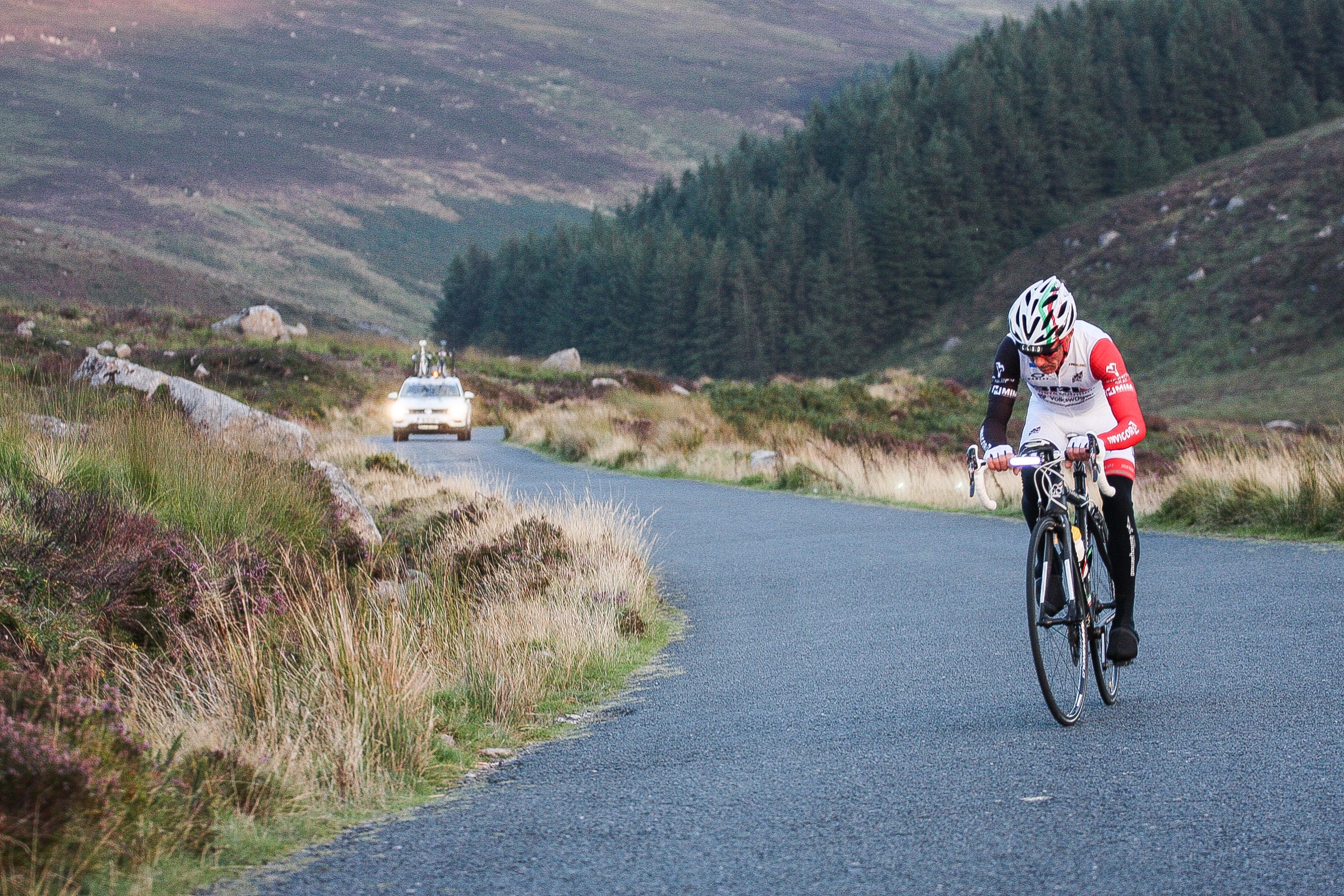
I went out hard. Within two miles, I was riding at 28 mph and it felt comfortable. I purposefully wanted to see who would respond, so I kept riding at a heart rate just below threshold.
There was certainly some concern among the crew that my heart rate was a little too high, but this old racer knew the race would quickly take shape, and I wanted my hand in it. Svata Bozak and Stephen Shrenck were riding at similar speeds, and I’ve learned that you simply cannot give riders of this calibre any space.
Our strategy was always to take the race to the race in the first 500 miles and then manage it from there. The first stop was planned for Castlebar. By then, we knew definitively where the fight lay: with Svata and Stephen.
Wonder why I focused on the 500-mile category in 2017? This is why.
To podium in these long races, speed over the first 500 miles is critical. That initial cushion of time is vital. It gives you and your team the flexibility you need to manage the race effectively.
We prepared surgically. Over this kind of distance, small time gains accumulate. He or she who can create economy in forward momentum will gain time.
Choice of bike for each road section, tyre selection, tyre pressures and gearing (especially over roads laid on top of bog) all influence forward motion. Even if the time gain is two minutes over 100 miles, think about it: it adds up.
Jill and I spent countless hours riding sections of the course to understand the road and identify where time could be gained.
For example, sections in the Ox Mountains are deceptively leg-sapping and mind-bending if you ride too big a gear. We planned to take time in these sections, knowing that other riders could fall prey to the road surface.
We also planned recovery sections: stretches where I could maintain speed but focus more on refuelling.
We knew there would be a delicate balance between sleep, rest and average speed. Our sleep stops were precisely choreographed: wash and change clothes, eat, sleep, get up, toilet (or bio-break, if you prefer that language!) and go again.
Jill planned my nutrition to give me the best chance of glycogen replenishment during that 70-minute stop. It worked like a charm.
Andy planned the clothing changes with an economy that was unparalleled.
The team and I were disciplined. The time we saved reflected our maturity and calibre.
I also had to adjust my race mindset.
Slowly, slowly, a mindset is created. Don’t believe anyone who says a race mindset is a switch. It’s negotiated over time, and each race has a particular infrastructure based on the ask.
I had to find my way into a Race Around Ireland mindset. This one was about unwavering concentration and discipline. It was about trusting the team to do their part so I could stay on the sharp edge of the race.
And even if things went awry (which they did), I had to trust that the team would figure it out.
It’s a radical kind of trust. Because of that trust, I was able to give every mile of this race my all.
I have never been so committed to maintaining forward momentum for 104 hours, 3 minutes and 8 seconds.
What an incredible experience.
We put the right people in the right roles.
The crew go through their own endurance journey, and each person performs differently under pressure, fatigue and depletion. Building a crew is a unique challenge, and it can’t be rushed.
You need people who have their own relationship to the race, to each other and to the joint commitment of getting to the finish safely and in a podium position.
The most important character trait in a crew member is resilience: the ability to absorb the impact but still move forward.
We learn something from every race, adding to our library of endurance knowledge. Expertise is the result of experience plus reflection.
We also carved out space within our strategy to respond to the race itself.
The race is a living, dynamic entity. Each competitor breathes life into it. The way each competitor rides and the strategy they employ add personality to the race. The weather shapes it. Your own performance on the day, or over several days, adds or removes limits. And, of course, there are always hidden factors.
One thing I’ve always done well is establish a relationship with The Race early on.
I respect The Race.
Yes, I battle. I fight. I attempt to put my mark on it. However, I always listen to what The Race has to say.
Here’s one quick example.
When the heavens opened and torrential rain came down in Tralee, I stopped to take shelter and warm up (thank you to the local community!).
It would have been so easy to sit it out, but I experienced an overwhelming intuition to push on.
So I did.
Then a local gentleman showed me the greatest of respect by standing in the torrential rain simply to usher me towards the start of Short Mountain. His words, spoken with utter conviction, mirrored my own inner sense:
“You’ve got this.”
That was The Race speaking.
Push on. Push on. Push on.
Through the driving rain. Through everything I can throw at you. Push on.
That’s what This Race demanded.
You’ve got this, Joe.
And I did. From that point onwards, I knew the top step on the podium was mine.
Every race rewards preparation.
If you’re working towards an ambitious endurance goal, Joe’s experience can help you build the strategy, develop the mindset and make the decisions that count when it matters most.
Train with Joe and put the details to work for you.
 PREV
 NEXT