 jill
 November 9, 2017
 jill
November 9, 2017
Decades on the bike have taught me a great deal about performance, persistence, preparation and the importance of mindset.
Some mindset lessons come from the races themselves. Others emerge from the miles, through experience, reflection and observation.
In this series, I share a few of the lessons the road has taught me, and what they might mean for life on two wheels and life on two feet.
435 miles into the 735-mile record attempt from Malin Head, the most northerly point in Ireland, to Mizen Head, the most southerly point, and back again, I lost belief in my ability to keep moving forward.
Maybe I lost it on the rough roads, in the headwind, fighting sleep deprivation or hailstones. It really doesn’t matter. The bottom line is that little by little it vanished.
I could feel this record attempt circling the drain. The negative voice in my head gathered steam, and the effort required to maintain my belief became a burden too heavy to bear.
We’ve all been there in some form or another, haven’t we?
It’s a profoundly lonely, desolate place. No one can reach you. You can’t even reach yourself.
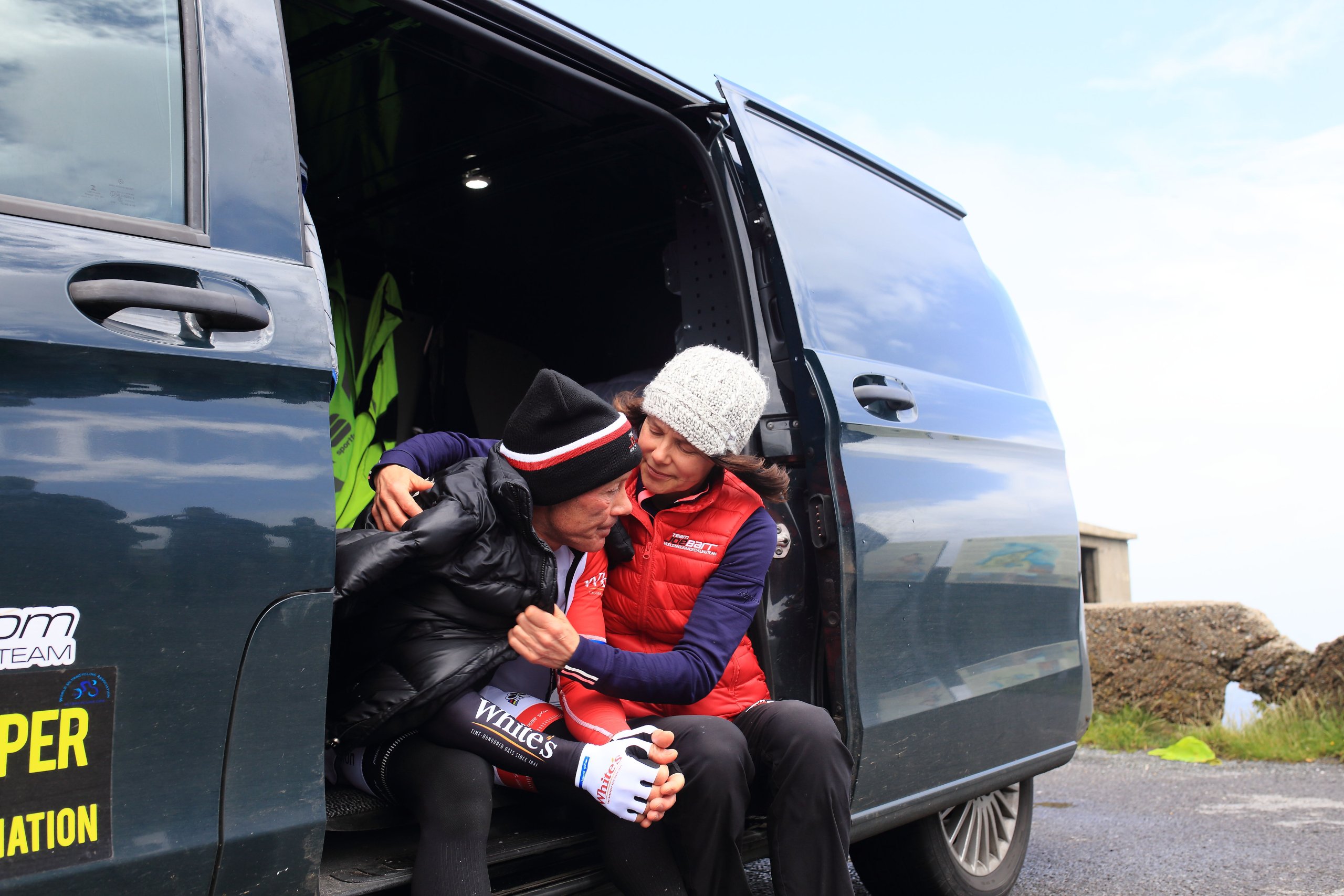
So, at 435 miles, I made an excuse to stop the bike and planted my feet on the ground. Jill walked slowly towards me from the crew car. She knew something was wrong. I looked up at her and said, “It’s not possible. I can’t.”
She paused, then responded.
“Joe, just keep the bike moving forward. We’ll work it out.”
We say that a lot at BarrUltra. After all, it’s the most fundamental thing we do.
Move forward.
Of course, it’s the most fundamental thing we do in life, too.
But false platitudes in desolate times like these are misplaced.
If the team had yelled, “Come on, Joe, you can do it!”, I could have argued with them. In fact, I was waiting to argue with them, desperate to argue with them, and I would have yelled straight back, “I can’t!”
All that would have done is reinforce my position, which was one of disbelief.
A loss of belief is a mental game, and my crew plays it well.
Once they’d got me moving again, the car became a hive of activity. They knew that, to dismantle my state of disbelief, they first needed solid data. It’s hard to argue with that.
They calmly came back to me with various calculations and what-if scenarios. Rather than trying to convince me I could succeed, they encouraged me to consider the possibility that success wasn’t entirely out of reach.
That conversation finished with a firm, “It’s possible,” before shutting the window on me.
It wasn’t a miraculous fix by any stretch of the imagination, but it was enough to halt the downward mental spiral.
As I kept the bike moving forward, I gave those what-if scenarios some space. It was a relief to let them hang in the air around me. I felt lighter.
And as I noticed that feeling, an interesting thought appeared.
What if I didn’t have to believe?
What if I simply suspended my disbelief for a while?
That might give me some respite from myself.
For the next couple of hours, I rode freely in that suspended state, no longer needing to believe or disbelieve. (Of note: my speed came up by about 2 mph.)
I wasn’t suddenly convinced I could do it. I wasn’t convinced I couldn’t, either. I had simply stepped away from the argument going on in my head.
And that was enough.
The crew continued to follow. They kept me nourished and talked calmly to me, giving me the space to transition into a state of possibility.
It helped, of course, that morning was coming. Never underestimate the promise of a new day.
At around 500 miles, it became possible again.
Not certain. Possible.
I knew it would be an almighty battle, but I was up for it.
The rest is history.
I now know that the bridge between impossible and possible is a suspension bridge.
Consciously suspending my disbelief was the defining choice of this race.
It taught me something important about those moments when belief deserts us. We often think we have to find our confidence again before we can move forward. We wait to feel stronger, more certain, more capable of meeting the challenge ahead.
But perhaps we don’t.
Perhaps we can give ourselves permission not to decide, just yet, whether something is possible or impossible.
We can let go of the argument, keep moving and allow the possibility of a different outcome to find some space.
My advice, if you find yourself in a situation where belief feels like a bridge too far, is to try suspending your disbelief.
And while you do that, keep yourself in forward motion.
It doesn’t have to be at any particular speed. Simple forward motion will do.
Possibility can reappear, but it needs to find you moving.
The lessons Joe brings to coaching have been earned on the road.
He understands what it takes to prepare for a big challenge, but also what happens when the plan starts to unravel, belief wavers and you need to find a way forward.
Working with Joe brings that experience into your own riding, helping you develop the preparation, judgement and confidence to meet your goals.
If you’re ready to find out what you’re capable of, start a conversation with Joe about coaching.
 jill
October 4, 2021
Decades on the bike have taught me a great deal about performance, persistence, preparation…
 jill
April 22, 2020
Decades on the bike have taught me a great deal about performance, persistence, preparation…
 jill
April 4, 2020
Decades on the bike have taught me a great deal about performance, persistence, preparation…
 PREV
 NEXT