 jill
jill
 August 23, 2017
 jill
August 23, 2017
jill
August 23, 2017
After thousands of miles of racing, we’ve learned that it’s rarely the big things that make life easier in the ultra-cycling crew car.
It’s the little things.
The things you don’t think about until you’re 30 hours into a race, everyone is tired, the weather has changed and someone is standing in the crew car wondering where on earth the clean bottles went.
We originally wrote this list back in 2017.
We’ve done a lot more racing since then, but the principle hasn’t changed.
When you’re supporting an ultra-cyclist for hours – or days – at a time, a well-organised crew car can make life considerably easier for everyone.
These are some of the things we’ve learned to keep close at hand.
The bottle tops pick up all manner of splash-back from the road – petrol, general debris, mud, and goodness knows what else.
A quick clean every time a bottle comes back into the car is a simple way to keep things hygienic.
You really don’t want your rider getting sick because something that looked clean wasn’t.
And we’ve seen it happen.
Lots of them.
And lots of different sizes.
As soon as you open a packet of food, put it into its own bag. Keep wet food away from dry food. Keep opened products contained. Protect things from spills.
It sounds obvious.
Until something leaks into the food box you really needed.
It is genuinely amazing how much rubbish a small group of people can generate when they are eating, drinking and changing kit around the clock.
Keep garbage bags accessible.
Preferably more than one.
And don’t let the rubbish situation become a crew problem at 2am.
Keep it somewhere everyone can reach easily.
We like to have it accessible in the car doors so there’s no excuse not to use it.
Your crew are handling bottles, food, clothing, equipment and all sorts of things throughout a long race.
Good hygiene helps protect everyone.
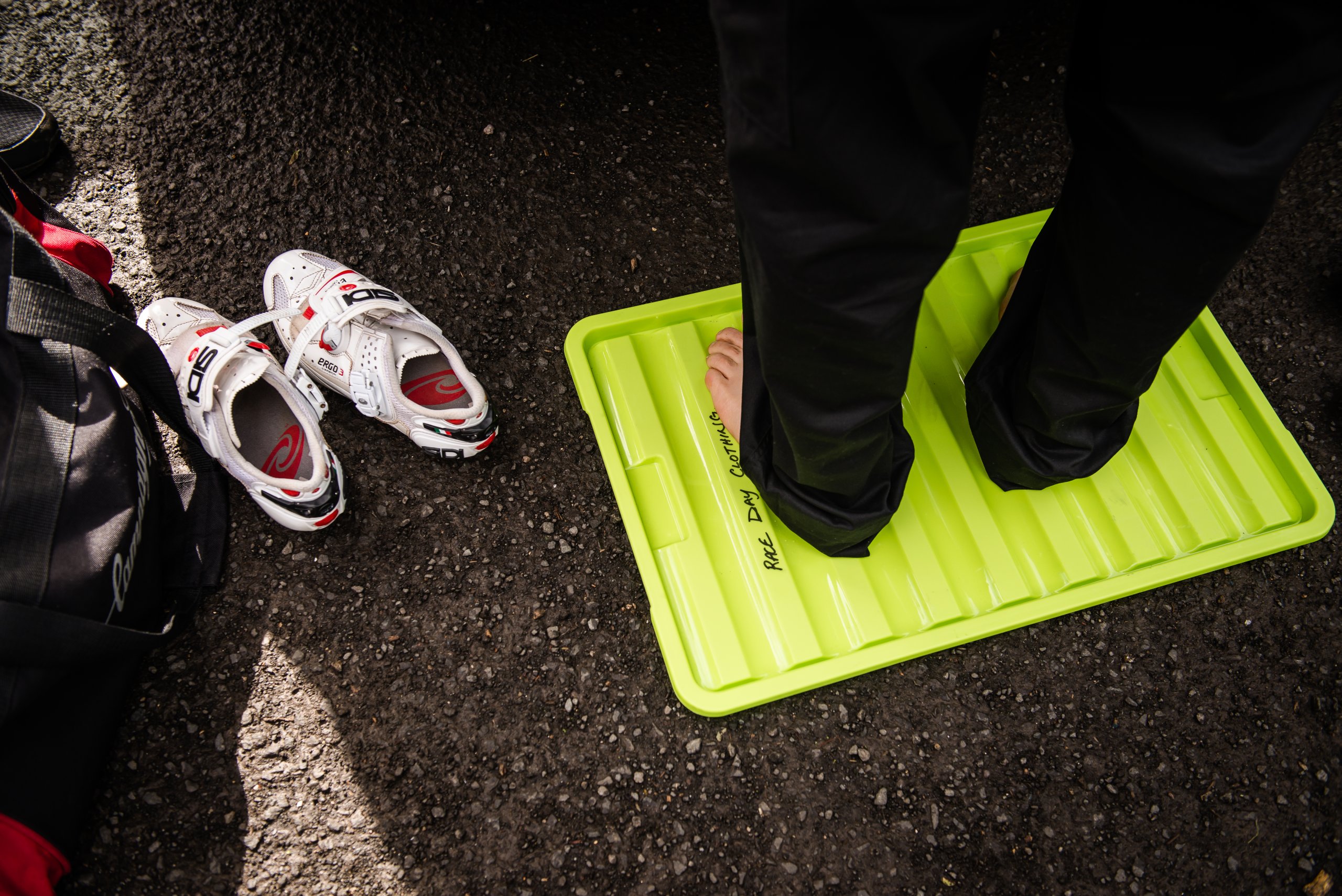
Label everything.
Boxes. Bags. Clothing. Food. Equipment.
And label it in BIG letters.
Because when you’ve been awake all night, your eyesight seems to deteriorate hour by hour.
What looked perfectly obvious at the start of the race suddenly becomes a very complicated question at 3am.
You’ll want to prepare bottles in advance so there is always one ready for your rider.
We usually keep the full bottles at the front and the clean, empty bottles at the back.
Simple organisation, but it means everyone knows what is ready to go.
And when everyone is tired, simple is good.
This is probably less about a particular piece of equipment and more about how you organise the whole vehicle.
Everything needs a home.
And everyone needs to know where that home is.
When the race starts, the crew car can quickly become a moving storage unit.
Without a system, things disappear.
With a system, even a tired crew can find what they need.
Your food system needs to be just as organised as your clothing.
Keep products grouped and clearly labelled.
Separate rider food from crew food.
And think about accessibility.
If something is needed regularly, it should not be stored underneath three boxes of things you haven’t used since the start.
The type you put underneath rugs at home.
They are surprisingly useful in a crew car.
Put them under electronics, chargers or other equipment on the dashboard or other flat surfaces and things are much less likely to slide around.
Trust me on this one.
Any mechanic will tell you that working on a bike is much easier when the bike is stable.
A proper bike stand isn’t always practical depending on the vehicle and race, but some way of securely supporting the bike can make everything from a quick adjustment to a bigger mechanical job considerably easier.
When you’re tired, you don’t need to make a simple job harder than it already is.
You are going to need power.
Phones. Lights. Computers. Cameras. Bike electronics. The list is long.
These days, we’d also make sure you have enough charging cables, adapters and backup power options for everything the crew relies on.
Because discovering that you have five devices and one charging cable is not a problem you want to solve halfway through the race.
The crew car might have plenty of lights, but there are always moments when an extra light is invaluable.
Changing a wheel.
Finding something in the back of the vehicle.
Sorting kit at the roadside.
Working outside the car in the middle of the night.
A couple of head torches and spare batteries take up very little space and can be worth their weight in gold.
At the first sign of rain, the rider needs access to appropriate clothing quickly.
Our wet bag lives somewhere immediately accessible rather than buried underneath everything else in the vehicle.
On longer races, we usually have two.
The important thing is not just having the clothing.
It’s being able to find it when you need it.
14. A dedicated clothing system
Clothing needs its own system.
Warm weather. Cold weather. Rain. Wind. Night riding. Spare kit.
Whatever system you use, make sure everyone on the crew understands it before the race starts.
A tired rider shouldn’t have to explain where their waterproof jacket is.
And a tired crew member shouldn’t have to empty half the car to find it.
This one is easy to overlook.
The crew are working too.
They are driving, navigating, feeding the rider, changing bottles, managing clothing, dealing with mechanical problems and making decisions, often through the night and sometimes for several days.
A few small comforts matter.
Good coffee.
Easy-access food.
Something warm to wear.
A clean, dry space to sleep when the opportunity comes.
Eye drops to refresh tired eyes.
Look after the crew and they are better equipped to look after the rider.
An ultra-endurance race isn’t just happening on the bike.
It is happening inside the crew vehicle too.
The organisation. The communication. The food. The bottles. The clothing. The mechanics. The navigation. The small decisions made when everyone is tired.
A good crew car isn’t just a vehicle.
It’s a moving control centre.
And the better organised it is before the race starts, the more capacity your crew has to focus on what really matters – keeping the rider moving.
Prepare the little things well, and the big things become easier.
The race starts long before the start line.
Whether you need help with your training and race strategy, or with the nutrition and fuelling that supports it, our coaching is built around you, your goals and the demands of ultra-endurance racing.
Joe brings the racing experience. Jill brings the nutrition. Together, we help you prepare for what’s ahead.
 PREV
PREV NEXT
NEXT